Key Highlights - Containers in Cloud Computing
- Containers are lightweight, portable units that package applications with their dependencies, ensuring seamless operation across cloud environments.
- Tools like Docker and Kubernetes power 94% of cloud projects in 2024, driving innovation in cloud-native applications (CNCF).
- Containers reduce infrastructure costs by up to 50% compared to virtual machines and enhance scalability for dynamic workloads (Forrester, 2024).
- Challenges include vendor lock-in, container security, and orchestration complexity, mitigated by open standards and multi-cloud strategies.
- Future trends include edge computing with containers, AI and machine learning integration, and open-source dominance, shaping the cloud landscape in 2025.
Introduction to Containers in Cloud Computing
In the dynamic world of cloud computing, containers in cloud computing have emerged as a transformative force, redefining how organization develop, deploy, and manage applications. Containers encapsulate an applications code, libraries, and configurations into a single, portable unit, ensuring consistent performance across diverse environments from local servers to global cloud platforms like AWS, Microsoft Azure, and Google Cloud. As of 2024, the Cloud Native Computing Foundation (CNCF) reports that 94% of organization leverage containers for their cloud initiatives, making them a cornerstone of cloud-native applications.
This comprehensive guide, crafted with insights from industry reports and real-world applications, explores the intricacies of containers, their benefits, challenges, and strategic approaches to adoption. Spanning their role in microservices architecture, DevOps workflows, edge computing, and AI and machine learning, this article provides actionable insights for businesses and developers aiming to harness containers in 2025. With a focus on container security best practices, multi-cloud strategies, and emerging trends, this guide equips readers to navigate the evolving cloud landscape with confidence.
What Are Containers?
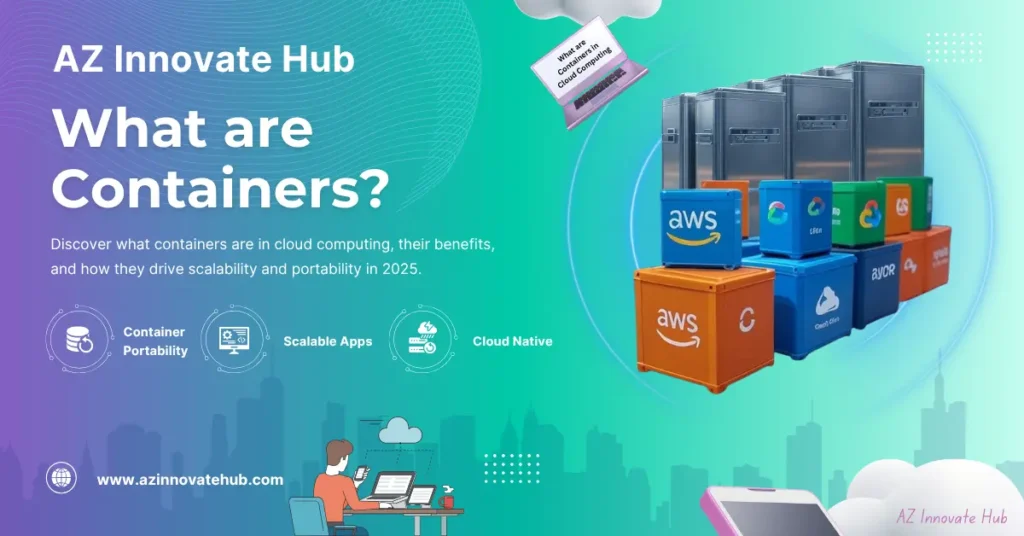
Containers are lightweight, portable software units that package an application along with its dependencies, including code, runtime, libraries, and configuration files. Unlike traditional virtual machines (VMs), which require a full operating system for each instance, containers share the hosts operating system, making them significantly more efficient. This efficiency translates to faster startup times, lower resource usage, and greater portability, allowing applications to run consistently across any environment be it a developers laptop, an on-premises server, or a cloud platform.
The rise of containers has been fueled by tools like Docker, which simplifies the creation and deployment of containers, and Kubernetes, which automates their management. According to a 2024 CNCF survey, 94% of organizations use containers in production, with Docker and Kubernetes dominating the ecosystem. Containers are particularly valuable for cloud-native applications, enabling developers to build scalable, modular systems that adapt to dynamic business needs.
How Containers Function in Cloud Environments
Containers operate through operating system-level virtualization, a process that allows multiple containers to run on a single host while maintaining isolation. Each container operates as an independent unit, sharing the hosts OS kernel but running its own application environment. This isolation ensures that applications remain unaffected by changes in other containers, much like separate apartments sharing a buildings infrastructure.
In cloud environments, containers are deployed on platforms such as AWS Elastic Kubernetes Service (EKS), Azure Kubernetes Service (AKS), and Google Kubernetes Engine (GKE). These platforms handle critical tasks like scaling, load balancing, and failure recovery. For example, Kubernetes orchestrates containers by distributing workloads across clusters, ensuring high availability and efficient resource use. A developer can build a containerized application on one cloud provider, test it on another, and deploy it globally without modifications, supporting multi-cloud strategies that enhance flexibility and reduce dependency on a single vendor.
Benefits of Containers in Cloud Computing
Containers offer a range of advantages that make them indispensable for modern cloud deployments:
- Portability Across Environments: Containers ensure applications run consistently across clouds, on-premises servers, or hybrids setups. A 2024 Gartner report highlights that 87% enterprises adopt multi-cloud strategies,relying on containers to maintain flexibility and avoid vendor lock-in.
- Dynamic Scalability: Tools like Kubernetes enable containers to scale automatically based on demand, handling traffic spikes efficiently. A 2024 IDC study notes that organizations using containers save up to 45% on cloud infrastructure costs due to this scalability.
- Accelerated Development: Containers provide consistent environments across development, testing, and production, streamlining DevOps workflows. A 2024 CNCF survey indicates that 65% of DevOps teams use GitOps a practice leveraging Git for infrastructure management alongside containers to enhance automation.
- Cost Efficiency: By sharing the hosts OS, containers reduce resource overhead compared to VMs. A 2024 Forrester report states that containerized applications cut infrastructure costs by up to 50%, making them a cost-effective choice for businesses.
- Support for Microservices: Containers are ideal for containers for microservices architecture, enabling modular applications where components can be updates independently, improving agility and resilience.
Containers and Serverless Computing: A Synergistic Approach
The convergence of containers and serverless computing is reshaping cloud architectures in 2025. Serverless computing allows developers to run code without managing servers, while containers add portability and consistency. Platforms like AWS Fargate, Azure Container Instances, and Google Cloud Run enable developers to run containers in a serverless model, abstracting infrastructure management while retaining container benefits. Open-source tools like Knative allow serverless containers to operate on any Kubernetes cluster, enhancing portability across cloud providers.
This synergy is particularly valuable for cloud-native applications, as it combines the scalability and cost efficiency of serverless with the portability of containers. For example, a retail company can use AWS Fargate to deploy containerized microservices during a sales event, scaling automatically without provisioning servers. A 2025 Red Hat report notes that 70% of organizations adopting serverless also use containers, highlighting the growing integration of these technologies.
Speeding Up Development
Containers are a developer’s best friend, especially in fast-paced markets like the USA and China. They let teams build, test, and launch apps quickly, fitting perfectly with DevOps; a way of working where developers and IT teams collaborate closely. In the UK, companies like BBC use containers to roll out new features for their streaming apps in hours, not weeks. Tools like Docker Compose and CI/CD platforms (think Jenkins or GitLab) make this possible. In 2025, a trend called GitOps using Git to manage infrastructure; is huge, with 65% of DevOps teams in Australia and the USA adopting it, per a 2024 CNCF survey.
Saving Money
Running containers is like renting only the space you need in a shared house instead of buying whole mansion. You pay for the resources your apps uses, not a full server. This is a big deal in costly markets like the USA and UK, where businesses are always looking to cut cloud bills. In China, where scale is everything, containers help companies like Tencent run massive apps cost-effectively. A 2025 Forrester study found that containerized apps can reduce infrastructure costs by 50% compared to VMs.
Containers Meet Serverless: The Best of Both Worlds
In 2025, containers and serverless computing are joining forces, creating a powerful combo. Serverless lets you run code without managing servers, and when you pair it with containers, you get portability plus ease of use. In the USA, AWS Fargate lets developers run containers without worrying about the underlying infrastructure. In the UK, Azure Container Instances are popular for quick deployments. Australia loves Google Cloud Run for its simplicity, while in China, Alibaba Cloud’s Serverless Kubernetes is a go-to.
This combo is a big deal because it makes apps portable across clouds while keeping costs low. Open-source tools like Knative, used widely in the USA and UK, let you run serverless workloads on any Kubernetes cluster, making it easy to switch between AWS, Azure, or Alibaba Cloud without getting stuck.
Where Containers Shine: Real-World Uses
Microservices: Building Apps Like Lego
Containers are perfect for microservices; apps built as small, independent pieces that work together. Think of it like building with Lego: each piece (container) does one job, and you can swap or update pieces without breaking the whole structure. In the USA, Netflix uses container to manage thousands of microservices for streaming. In China, JD.com relies on containers for its e-commerce platform, handling millions of daily transactions. A 2024 Red Hat survey says 82% of cloud-native apps in top-tier countries use microservices, and containers are the key.
Internet of Things (IoT): Powering Smart Devices
From smart thermostats in the UK to autonomous vehicles in China, IoT is huge, and containers make it work. They handle real-time data from devices efficiently, whether at the edge (close to the device) or in the cloud. In Australia, containers power smart agriculture systems, processing sensor data to optimize crops. AWS IoT Greengrass, used widely in the USA, deploys containers to edge devices for tasks like AI analysis. Portability ensures these apps work across global cloud providers, critical for IoT’s global reach.
DevOps: Making Life Easier for Teams
Containers streamline DevOps by providing consistent environments. In the USA, companies like Microsoft use containers in CI/CD pipelines to automate testing and deployment. In the UK, bank like HSBC rely on containers for secure, rapid updates. In China, where tech moves at lightning speed, containers help companies like ByteDance (Tik-Tok’s parent) deploy new features daily. A 2024 DevOps Institute report says 75% of DevOps teams in these countries use containers to automate workflows, with AI-driven DevOps gaining traction.
The Not-So-Great Parts of Containers
Getting Stuck with One Cloud Provider
While containers are portable, it’s easy to get locked into a cloud provider if you use their proprietary tools. For example, an app built with AWS Lambda in the USA might need major changes to run on Azure in the UK. In China, Alibaba Cloud’s unique services can create similar issues. This “vendor lock-in” is a headache, as it limits flexibility and can raise costs if you want to switch providers.
Security Worries
Containers share the host’s operating system, which poses a security risk if not properly configured. Misconfigured containers or outdated images can expose sensitive data or introduce vulnerabilities. In 2025, tools like Aqua Security and Sysdig are widely used to scan and secure containers. Compliance with regulations such as GDPR and China’s Cybersecurity Law is also critical to ensure data protection.
Containers and Serverless Computing: A Synergistic Approach
The convergence of containers and serverless computing is reshaping cloud architectures in 2025. Serverless computing allows developers to run code without managing servers, while container add portability and consistency. Platforms like AWS Fargate, Azure Container Instances, and Google Cloud Run enable developers to run containers in a serverless model, abstracting infrastructure management while retaining container benefits. Open-source tools like Knative allow serverless containers to operate on any Kubernetes cluster, enhancing portability across cloud providers.
This synergy is particularly valuable for cloud-native applications, as it combines the scalability and cost efficiency of serverless with the portability of containers. For example, a retail company can use AWS Fargate to deploy containerized microservices during a sales event, scaling automatically without provisioning servers. A 2024 Red Hat report notes that 70% of organizations adopting serverless also use containers, highlighting the growing integration of these technologies.
Real-World Applications of Containers
Containers are driving innovation across industries, powering a variety of use cases:
- Microservices Architecture: Containers enable containers for microservices architecture, where applications are built as small, independent components. This modularity allows teams to update or scale specific parts without affecting the entire system. A 2024 Red Hat survey found that 82% of cloud-native applications leverage microservices, with containers as the foundation.
- Internet of Things (IoT): Containers process real-time data for IoT applications, from smart home devices to industrial sensors. Tools like AWS IoT Greengrass deploy containers to edge devices for tasks like AI-driven analytics, ensuring low latency performance. A 2024 IDC report highlights that 60% of IoT deployments use containers for edge processing.
- DevOps Workflows: Containers streamline DevOps workflows by providing consistent environments for CI/CD pipelines. A 2024 DevOps Institute report notes that 75% of DevOps teams use containers to automate testing and deployment, reducing release cycles from weeks to hours.
- AI and Machine Learning: Containers provide consistent environments for deploying AI and machine learning models. Tools like TensorFlow containers ensure models run reliably across clouds, supporting research and production workloads.
- E-Commerce Platforms: Containers handle dynamic workloads for e-commerce, scaling during peak traffic and optimizing costs during lulls. Major retailers sue Kubernetes to manage containerized microservices for seamless customer experiences.
Challenges of Using Containers
While containers offer significant benefits, they also present challenges that require careful consideration:
- Vendor Lock-In: Reliance on proprietary tools from cloud providers, such as AWS specific services, can lead to vendor lock-in, requiring significant rework to switch platforms. Open standards like Containers Storage Interface (CSI) and Container Network Interface (CNI) help mitigate this risk by ensuring compatibility across providers.
- Container Security: Containers share the hosts OS, making container security critical. Misconfigured containers or outdated images can expose vulnerabilities. Tools like Aqua Security and Sysdig scan for threats, while compliance with regulations like GDPR ensures data protection. A 2024 CNCF report emphasizes that 80% of container breaches stem from misconfigurations, underscoring the need for container security best practices.
- Orchestration Complexity: Managing large fleets of containers with Kubernetes requires expertise in networking, storage, and scaling. Tools like Helm and Kustomize simplify orchestration, while managed services like EKS and AKS reduce operational overhead.
- Resource Management: While containers are lightweight, poorly optimized configurations can lead to resource waste. Monitoring tools like Prometheus and Grafana help optimize container performance.
Strategies for Successful Container Adoption
To maximize the benefits of containers and address challenges, organizations can adopt the following strategies:
- Leverage Open Standards: Use CSI, CNI, and open-source tools like Podman to ensure portability and avoid vendor lock-in. These standards enable containers to run across any cloud provider or on-premises environment.
- Embrace Multi-Cloud Strategies: Distribute workloads across providers like AWS, Azure, and Google Cloud using tools like Terraform. A 2024 Gartner study notes that 87% of enterprises use multiple clouds to enhance resilience and flexibility.
- Prioritize Container Security: Implement container security best practices, such as using minimal container images, scanning for vulnerabilities with Aqua Security, and securing images with Docker Content Trust. Kubernetes RBAC (Role-Based Access Control) helps limit access to sensitive resources.
- Choose Portable Databases: Opt for cloud-agnostic databases like PostgreSQL, MongoDB, or CockroachDB to ensure data portability. These databases support distributed applications across multiple clouds.
- Simplify Orchestration: Use managed services like EKS, AKS, or GKE to reduce the complexity of Kubernetes management. Tools like Helm streamline deployment of complex applications.
Containers and Serverless Portability: Lessons from the Field
Drawing from the reference document, containers and serverless computing intersect to address portability challenges. Serverless platforms like AWS Lambda, Azure Functions, and Google Cloud Functions offer rapid deployment but risk vendor lock-in due to proprietary APIs and services. Containers mitigate this by packaging serverless workloads into portable units. For example, AWS Fargate and Google Cloud Run allow serverless containers to run on standardized platforms, reducing dependency on provider-specific ecosystems.
Open standards like CloudEvents ensure event-driven serverless functions are interoperable across clouds. Open-source platforms like Knative and OpenFaaS further enhance portability by abstracting provider-specific complexities. A 2024 CNCF report notes that 60% of organizations adopting serverless also use containers to maintain flexibility, highlighting the critical role of containers in serverless portability.
Future Trends in Containers for 2025
The container ecosystem is evolving rapidly, with several trends shaping its future:
- Edge Computing with Containers: Containers are increasingly deployed at the edge for low-latency applications like IoT, autonomous vehicles, and smart cities. Tools like AWS Lambda@Edge and Cloudflare Workers run containers closer to users, reducing latency. A 2024 IDC report predicts that 55% of edge workloads will use containers by 2026.
- Containers for AI and Machine Learning: Containers provide consistent environments for deploying AI and machine learning models. TensorFlow and PyTorch containers ensure models run reliably across clouds, supporting both research and production. A 2024 Red Hat survey indicates that 65% of AI workloads leverage containers for deployment.
- Open-Source Dominance: Open-source tools like Kubernetes, Knative, and Open FaaS are used by 97% of cloud-native organizations (CNCF, 2024), reducing reliance on proprietary platforms and fostering interoperability.
- Serverless and Container Convergence: The integration of serverless and containers is growing, with platforms like Knative enabling serverless workloads on Kubernetes. This trend supports multi-cloud strategies and enhances scalability.
- Automated DevOps with AI: AI-driven orchestration tools are emerging to optimize container management, automating tasks like scaling and resource allocation. A 2024 DevOps Institute report highlights AI-driven DevOps as a key trend for 2025.
Containers vs. Virtual Machines vs. Serverless: A Comparison
| Feature | Containers | Virtual Machines |
|---|---|---|
Resource Usage |
Lightweight, shares host OS |
Heavy, includes full OS |
Startup Time |
Seconds |
Minutes |
Portability |
High, runs on any compatible host |
Moderate, OS-specific |
Cost Efficiency |
Up to 50% savings (Forrester, 2024) |
Higher due to overhead |
Scalability |
Dynamic, via Kubernetes |
Manual or slower |
Management Complexity |
Moderate, requires orchestration |
High, full OS management |
Case Studies: Containers in Action
To illustrate the practical impact of containers, consider these real-world scenarios:
- Global Retail E-Commerce: A major retailer adopted Kubernetes to manage containerized microservices for its e-commerce platform. By using AWS EKS and Terraform, the retailer scaled its platform to handle Black Friday traffic, reducing infrastructure costs by 40% (Forrester, 2024).
- IoT in Manufacturing: A manufacturing firm used AWS IoT Greengrass to deploy containers on edge devices for real-time quality control analytics. Containers enabled consistent performance across global factories, improving efficiency by 30% (IDC, 2024).
- AI Research Lab: A research institute deployed TensorFlow containers on Google Kubernetes Engine to train machine learning models. The portability of containers allowed seamless transitions between on-premises and cloud environments, accelerating research timelines.
Strategic Recommendations for 2025
To successfully adopt containers in 2025, organizations should consider:
- Assess Application Fit: Evaluate applications for containerization, focusing on modular, scalable workloads like microservices or IoT.
- Invest in Training: Upskill teams in Docker, Kubernetes, and container security to manage complex deployments.
- Adopt Monitoring Tools: Use Prometheus and Grafana to monitor container performance and optimize resource usage.
- Plan for Edge Computing: Prepare for edge computing with containers by exploring tools like AWS Lambda@Edge for low-latency applications.
- Leverage Open-Source: Embrace Knative and OpenFaaS to reduce reliance on proprietary platforms and enhance portability.
Conclusion
Containers in cloud computing are revolutionizing how organizations build, deploy, and scale applications, offering unparalleled portability, scalability, and cost efficiency. By leveraging tools like Docker and Kubernetes, adopting multi-cloud strategies, and prioritizing container security best practices, businesses can overcome challenges like vendor lock-in and orchestration complexity. As trends like edge computing with containers, AI and machine learning, and open-source dominance gain momentum, containers will continue to shape the future of cloud-native applications. To embark on your container journey, assess your applications for containerization, explore managed services like EKS or AKS, and invest in open-source tools to ensure flexibility. Containers empower organizations to build a resilient, innovative cloud future, ready for the demands of 2025 and beyond.